
Why integrate lease accounting into the month-end close?
Building lease accounting into your month-end close is crucial. It keeps the numbers accurate and keeps you compliant with standards like ASC 842.
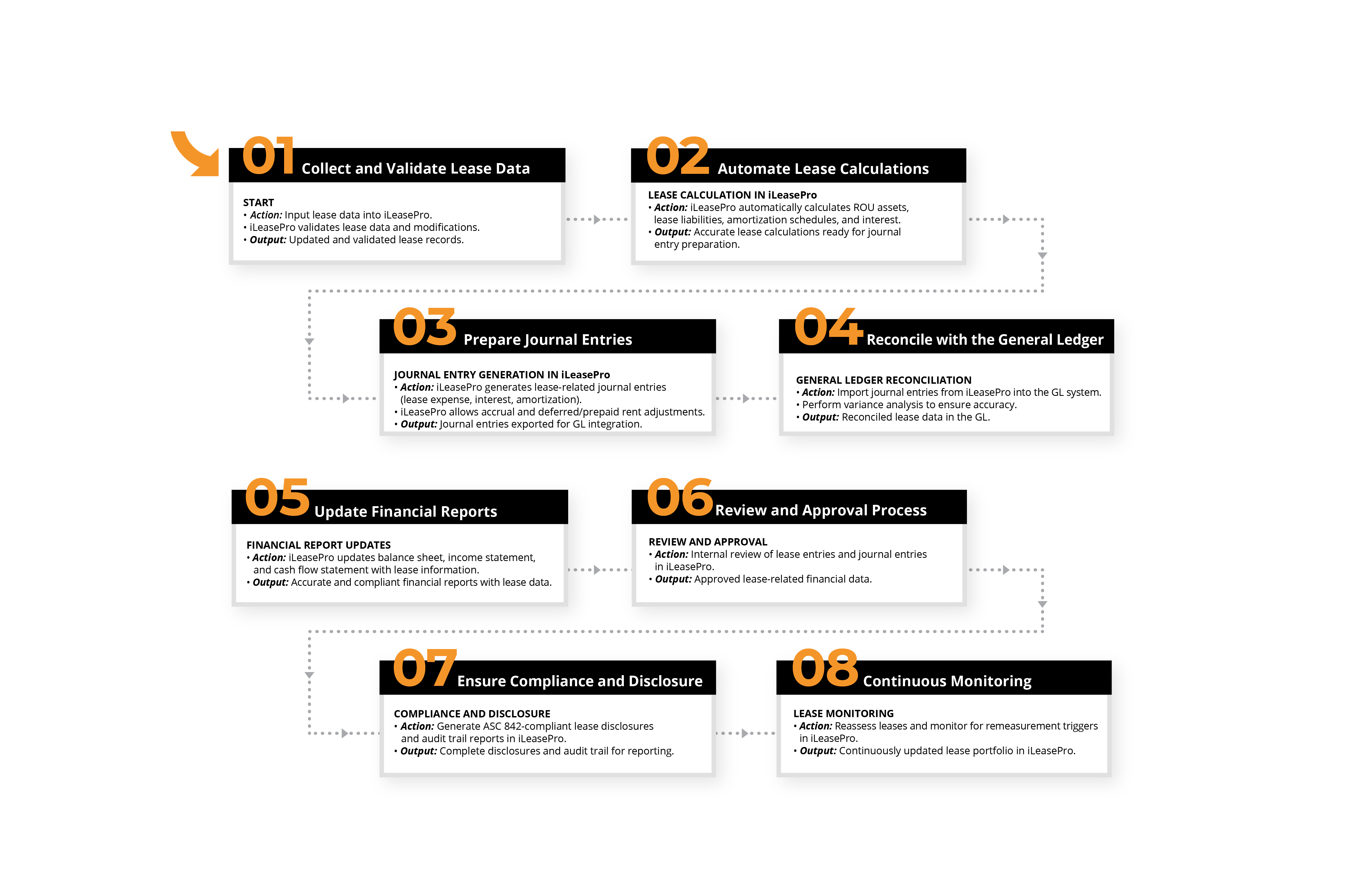
With iLeasePro, you can streamline the process, automate tasks, and reduce errors. Here is a step-by-step guide to building lease accounting into your month-end close. Each step shows how it helps along the way.
Key takeaways
- Collect and validate every lease change first: new leases, modifications, terminations, and renewals.
- Calculate the right-of-use asset, the lease liability, amortization and interest before you create the journal entries. A finance lease recognizes amortization and interest as two separate costs; an operating lease recognizes a single lease cost (ASC 842-20-25-5, ASC 842-20-25-6). The two need not be separate income statement lines (ASC 842-20-45-4), but finance lease cost is disclosed split between them (ASC 842-20-50-4(a)).
- Post the journal entries, then reconcile the lease transactions with the general ledger.
- Update the balance sheet, income statement, and cash flow statement, then review and approve before the close is final.
- Disclosures and ongoing checks for remeasurement or reclassification complete the cycle.

Step 1: Collect and Validate Lease Data
Action: Enter all relevant lease data into iLeasePro: new leases, modifications, terminations and renewals. These are the events ASC 842 makes you account for (ASC 842-10-25-1, ASC 842-20-30-1, ASC 842-20-40-1).
How it helps: The platform validates lease data. It tracks lease changes automatically (e.g., modifications and reassessments) and ensures the data complies with ASC 842 standards.
Output: An updated lease database that complies with ASC 842, ready for the next calculations.
Step 2: Automate Lease Calculations (ASC 842-Compliant Calculations)
Action: Use iLeasePro to calculate, automatically, the right-of-use (ROU) asset and lease liability that ASC 842-20-30-1 requires you to measure at commencement (recognition: ASC 842-20-25-1). It works from inputs like payment schedules, discount rates, and lease terms.
How it helps: The software computes the amortization of ROU assets and the interest on lease liabilities. This ensures compliance with ASC 842's detailed requirements.
Output: Accurate lease liability and ROU asset values, plus amortization and interest schedules, ready for journal entry creation.
Step 3: Prepare Journal Entries (ASC 842-Compliant Journal Entries)
Action: Generate journal entries in iLeasePro to record the lease expenses, ROU asset amortization, and interest on lease liabilities.
How it helps: Prepares all the journal entries that ASC 842 requires, automatically. That includes adjustments for accruals, prepaid or deferred rent, and lease modifications.
Output: Journal entries that comply with ASC 842, exported for import into your general ledger (GL) system.

Step 4: Reconcile with the General Ledger
Action: Import or upload the journal entries from iLeasePro into your GL system. Then reconcile the lease-related transactions with the general ledger.
How it helps: Supports seamless GL account mapping. This supports the current and noncurrent split of the lease liability. ASC 842-20-45-1 defers that classification to the same considerations as other financial liabilities, which is ASC 210.
Output: Reconciled lease-related entries in your GL that comply with ASC 842.

Step 5: Update Financial Reports (ASC 842-Compliant Reporting)
Action: Update your financial statements to reflect lease-related assets, liabilities, expenses, and interest, as required by ASC 842. That means the balance sheet, income statement, and cash flow statement (ASC 842-20-45-1 through 45-5).
How it helps: Provides detailed ASC 842 data, including:
- ROU Asset Cost
- Accumulated Amortization
- Net ROU Asset
- Current Lease Liability
- Non-Current Lease Liability
- Total Lease Liability
- Remaining Lease Term
- Remaining Lease Payments
- Expense Amortization
- Expense Interest
- Expense Total
- Weighted Average Discount Rate
- Weighted-Average Remaining Lease Term
The weighted-average figures are disclosed separately for finance and operating leases, as ASC 842-20-50-4(g) requires.
This data updates your financial statements to reflect the proper classification of ROU assets and lease liabilities. It also categorizes expenses (operating vs. finance leases) per ASC 842 requirements.
Output: Accurate financial reports that comply with ASC 842.

Step 6: Review and Approval Process
Action: Review all lease-related journal entries and financial reports internally. Do this to ensure compliance with ASC 842 before you finalize the month-end close.
How it helps: iLeasePro’s review tools allow a detailed audit of all lease-related data and calculations. This ensures accuracy and ASC 842 compliance before you submit for approval.
Output: Reviewed and approved lease-related journal entries and financial statements that comply with ASC 842.

Step 7: Ensure ASC 842 Compliance and Disclosure
Action: Make the proper ASC 842 disclosures in the financial statements (ASC 842-20-50-4, ASC 842-20-50-6). Include key details like lease classifications, total lease payments, and ROU asset amortization.
How it helps: Generates the required ASC 842 lease disclosures automatically, including all necessary financial statement notes and supporting schedules. It also keeps a complete audit trail for external review.
Output: Complete financial disclosures and audit documentation that comply with ASC 842.

Step 8: Continuous Monitoring (Ongoing ASC 842 Compliance)
Action: Keep reassessing leases in iLeasePro for changes that might trigger remeasurement or reclassification, as required under ASC 842.
How it helps: Tracks lease modifications, reassessments and economic changes. Remeasurement follows the triggers in ASC 842-10-35-4. Reclassification is narrower. ASC 842-10-25-1 bars reassessing classification after commencement except on a modification that is not a separate contract, and requires a lessee to reassess it on a change in the lease term or in the purchase-option assessment.
Output: A lease portfolio that stays current and complies with ASC 842, with automated remeasurement triggers and reclassification where needed.
Implementing iLeasePro for Enhanced Compliance
What are iLeasePro's key benefits?
Streamlined Accounting with Limited Resources: iLeasePro simplifies the lease accounting process. Your company can stay compliant with ASC 842 standards without specialized accounting staff, which saves both time and money.
Manage Complex Lease Portfolios with Ease: Whether you manage real estate, equipment, or vehicle leases, iLeasePro helps you classify, organize, and track your diverse lease portfolio with ease. It works no matter the complexity or asset type.
Ensure Compliance Across Multiple Locations: iLeasePro provides centralized lease management. This ensures consistency and compliance with ASC 842 across all branches and locations, with seamless oversight from a single platform.
Group-Specific Financial Tracking: With iLeasePro, you can monitor lease costs at the group level. This shows clearly how leases affect each program or initiative, so financial planning and reporting are more accurate.
Accurate Lease Classification: The iLeasePro Classification Wizard automates classifying your leases as operating or finance leases. This ensures compliance with ASC 842 and simplifies your financial reporting.
Seamless Management of Lease Modifications and Renewals: Manage lease modifications, renewals, and remeasurements with ease on iLeasePro’s intuitive platform. This keeps your company compliant as lease agreements change.
Affordable Automation for Lease Accounting: iLeasePro is an intuitive, cost-effective way to automate your lease accounting. It reduces manual errors and saves your company valuable resources without breaking the budget.
Enhanced Transparency and Accountability: iLeasePro ensures accurate, real-time reporting for all stakeholders. Your company can maintain the highest levels of financial transparency and accountability.
Audit-Ready Financial Reporting: With iLeasePro, your lease data is organized and compliant, so your company is ready for an audit. External reporting is accurate, complete, and easy to navigate during reviews or audits.
Let iLeasePro Help You in Your Lease Accounting Journey
ASC 842 compliance is a substantial but manageable task, especially with the right tools and strategies in place.
With structured lease management and comprehensive lease analysis in iLeasePro, your company can meet compliance requirements efficiently. It can also gain strategic advantages through better lease portfolio management.
Follow these steps to streamline your processes, pass audits with confidence, and unlock financial improvements.
To get started, call us at 888-351-4606 or email us at info@ileasepro.com. We also have plenty of great information about lease accounting software on our website at iLeasePro. You can chat with a live representative there as well.