Navigating the accounting shift from ownership to lessee
Lease accounting has never been simple, and the adoption of ASC 842 brought it front and center for executives and auditors alike. Nearly all leases now appear on the balance sheet as right-of-use (ROU) assets and lease liabilities, making sale-leasebacks much more transparent—and more complex.
When a company sells property and leases it back, it moves from reporting the property as PP&E (property, plant, and equipment) to being a lessee under ASC 842. This shift doesn’t change the economics of the transaction, but it does change how results are reported, how ratios move, and how investors interpret financial health.
Lease Classification Under ASC 842
ASC 842 requires leases to be classified as either:
- Finance Lease — Recognized with interest expense on the lease liability and amortization expense on the ROU asset.
- Operating Lease — Recognized as a single straight-line lease expense over the term.
The classification is determined by criteria such as whether ownership transfers, whether a bargain purchase option exists, or whether the lease term covers most of the asset’s useful life.
Real-World Example: A Healthcare Provider Sale-Leaseback
A regional healthcare provider owns its headquarters, valued at $20 million. To unlock capital for expansion, it sells the property to an investor and immediately leases it back for 15 years.
- Sale price: $20 million
- Lease term: 15 years
- Present value of lease payments: $15 million
- Leaseback classification: Finance lease — the term covers most of the asset’s remaining useful life.
First Question: Did a Sale Actually Occur?
Before any entry is written, ASC 842-40 asks whether the transfer qualifies as a sale at all, applying the control tests in the revenue standard. If it does not, there is no sale to account for — the arrangement is a financing, and the answer changes completely.
Two things commonly stop a sale-leaseback being a sale:
- The leaseback is a finance lease. If the seller-lessee would classify the leaseback as a finance lease, control never passed — you have kept substantially all the economic benefit of the asset. The transfer is not a sale.
- The seller holds a repurchase option. An option to buy the asset back generally prevents sale accounting, unless it is exercisable at the asset’s then fair value and alternative assets are readily available in the market.
This is the trap in sale-leasebacks, and it catches the transactions that look most attractive commercially. A long leaseback on a purpose-built property — exactly the arrangement a healthcare provider or manufacturer is most likely to enter — is the one most likely to classify as a finance lease and therefore fail sale accounting. The classification tests are in ASC 842 lease classification.
Journal Entries: A Failed Sale-Leaseback
The example above states a finance-lease leaseback, so on those facts no sale occurred. That is not a technicality — it changes every entry. The building is never derecognised, no right-of-use asset arises, and the $20 million is debt.
Step 1: Record the proceeds as a financing
Cash comes in, and a financial liability goes up. The building stays exactly where it was.
Dr. Cash                                 20,000,000
    Cr. Financial liability                       20,000,000
No gain is recognized, even if the property was worth more than book value. There is no disposal, so there is nothing to recognize a gain on — which is often the first surprise for a finance team that entered the transaction expecting one.
Step 2: Keep depreciating the building
The asset remains on the balance sheet at its existing carrying amount and continues on its existing depreciation schedule, unchanged by the transaction.
Dr. Depreciation expense                      xxx,xxx
    Cr. Accumulated depreciation                     xxx,xxx
Step 3: Split each payment between interest and principal
Payments of $1.5 million a year are not lease payments; they service the financing. Assuming a first-year interest component of $600,000:
Dr. Interest expense                         600,000
Dr. Financial liability                        900,000
    Cr. Cash                                       1,500,000
Compare that with what a successful sale-leaseback would have produced — derecognition of the building, any gain taken to income, and a right-of-use asset and lease liability recognized in its place. The cash flows are identical. The financial statements are not.
Why This Matters
- Balance Sheet: the building never leaves, and a $20M financial liability arrives beside it. A successful sale-leaseback would instead have removed the building and recognized a $15M right-of-use asset and lease liability.
- Income Statement: depreciation continues on the building as before, plus interest on the financing. There is no gain on disposal, because there was no disposal.
- Ratios: leverage rises by the full $20M rather than the $15M present value of the lease payments, and total assets do not fall. Both effects run the wrong way for a company that entered the transaction to strengthen its balance sheet.
- Investor Optics: the statements show borrowing secured on a property the company still reports owning, which is a harder story to tell than the one the transaction was designed to tell.
None of this is a reason to avoid sale-leasebacks. It is a reason to test whether a sale occurred before signing, because the leaseback term you negotiate is what decides it — and a term long enough to make the leaseback a finance lease is long enough to cost you the accounting outcome you wanted.
Risks to Consider
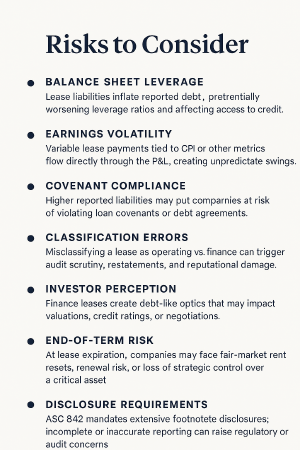
- Balance Sheet Leverage — Lease liabilities inflate reported debt, potentially worsening leverage ratios and affecting access to credit.
- Earnings Volatility — Variable lease payments tied to CPI or other metrics flow directly through the P&L, creating unpredictable swings.
- Covenant Compliance — Higher reported liabilities may put companies at risk of violating loan covenants or debt agreements.
- Classification Errors — Misclassifying a lease as operating vs. finance can trigger audit scrutiny, restatements, and reputational damage.
- Investor Perception — Finance leases create debt-like optics that may impact valuations, credit ratings, or negotiations.
- End-of-Term Risk — At lease expiration, companies may face fair-market rent resets, renewal risk, or loss of strategic control over a critical asset.
- Disclosure Requirements — ASC 842 mandates extensive footnote disclosures; incomplete or inaccurate reporting can raise regulatory or audit concerns.
Final Takeaway
For any company considering a sale-leaseback, ASC 842 changes how the transaction is reported, not the underlying economics. The classification, recognition of liabilities, and ongoing expense presentation all influence how investors, auditors, and lenders view the company.
Proper planning, accurate calculations, and clear communication of risks are essential to ensure compliance and present the transaction in the best possible light.